
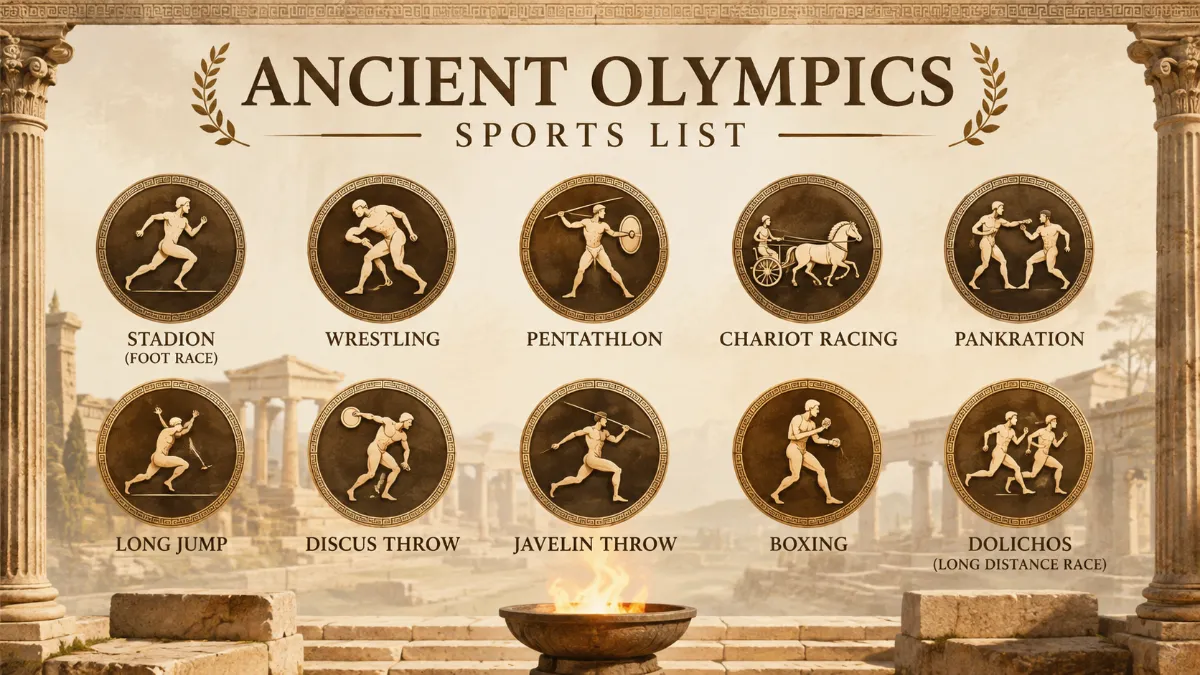
Ancient Olympics sports list highlights the running races, combat contests, pentathlon events and horse competitions held at Olympia in Greece. The Games ran from 776 BCE to 393 CE. They honoured Zeus and tested physical skill in a setting where male athletes competed without clothing.
At first, the Olympic festival lasted one day. However, by 684 BCE, it had expanded to three days. During the fifth century BCE, the programme reached five days. Therefore, that growth reflects how the event moved from one famous foot race into a broad athletic festival.
Still, the ancient programme was not a direct copy of the modern Olympics. There were no lanes marked like a present-day track, no weight classes in boxing and no timed rounds. Instead, victory depended on strength, stamina, technique and the willingness to endure severe physical pressure.
What events appear in the ancient Olympics sports list?
The ancient Olympics sports list can be grouped into three broad areas: running, combat sports and field or equestrian events. In particular, the seven most recognisable competitions were the stadion, diaulos, dolichos, hoplitodromos, wrestling, boxing and pankration.
- Running: stadion, diaulos, dolichos and hoplitodromos.
- Combat: wrestling, boxing and pankration.
- Multi-event and field contests: pentathlon, long jump, discus and javelin.
- Equestrian events: horse races and chariot racing.
Some events were separate contests while others formed the pentathlon. Therefore, a simple list can hide an important detail: ancient Greek sport combined individual specialisation with all-round athletic ability.
How did the ancient Greek running races work?
Ancient Greek running races measured different forms of endurance. For example, the stadion tested explosive speed, while the diaulos required athletes to turn and repeat the course. Meanwhile, longer races demanded pacing, balance and sustained effort across several laps.
Stadion: why was the first race so important?
The stadion was a sprint of about 192 metres. It was the first recorded Olympic event and ran from one end of the Olympia track to the other. As a result, the race became the central test of speed during the earliest Olympic festivals.
Diaulos: how far did athletes run?
The diaulos covered two stadion lengths, or roughly 384 metres. Athletes had to complete the outward section then return along the track. Consequently, that change of direction made the race more demanding than a simple straight sprint.
Dolichos: what made the long race different?
The dolichos was an endurance race covering 7 to 24 laps. Depending on the distance used, it ranged from about 1,500 to 5,000 metres. Therefore, a competitor choosing the wrong pace could lose strength well before reaching the finish.
Hoplitodromos: why did runners carry armour?
The hoplitodromos combined speed with military equipment. Athletes ran while wearing bronze armour and carrying a shield. Thus, the event represented battlefield movement and demanded controlled acceleration rather than the relaxed technique of a modern sprint.
For readers comparing ancient and modern sport, the hoplitodromos offers a useful distinction. Ancient contests often valued military readiness, whereas modern athletics usually separates combat equipment from running performance. That difference makes the race historically distinctive.
How were wrestling, boxing and pankration different?
Wrestling, boxing and pankration were the main combat sports at Olympia. Although each contest rewarded physical control, the rules created very different challenges. Wrestling focused on takedowns, boxing on striking and pankration on a broad combination of both.
| Sport | Main objective | Distinctive feature |
|---|---|---|
| Wrestling | Force the opponent to the ground | Three successful falls decided the contest |
| Boxing | Defeat the opponent through striking | No time limits or weight classes |
| Pankration | Combine striking and grappling | Biting and eye-gouging were banned |
Wrestling: how did an athlete win?
Ancient wrestling was mainly a standing contest. A fighter won by forcing the opponent to the ground three times. In addition, the sport was valued as a form of military exercise without weapons, which explains its strong place in Greek athletic culture.
Boxing: what rules shaped the contest?
Boxers wrapped leather straps called himantes around their hands. Early straps were softer, but later versions used harder leather. Consequently, there were no weight divisions or time limits, so bouts could become tests of patience as well as power.
Pankration: why was it considered so severe?
Pankration blended boxing with wrestling. Almost every technique was permitted except biting and eye-gouging. Therefore, the contest demanded striking skill, grappling strength and tactical awareness, making it one of the toughest events in the ancient programme.
The International Olympic Committee’s overview of the ancient Olympic Games provides useful historical context for these combat events. However, descriptions should not be treated as exact modern rulebooks because surviving evidence is incomplete.
What was included in the ancient pentathlon?
The pentathlon combined five events: the long jump, javelin, discus, stadion and wrestling. It therefore tested speed, explosive movement, throwing distance and close physical combat within one competition.
- Long jump: Athletes jumped while holding weights called halteres.
- Javelin: Competitors threw a wooden spear-like implement for distance.
- Discus: Athletes measured distance with a stone or metal disc.
- Stadion: The 192-metre sprint tested speed.
- Wrestling: The final discipline tested physical control.
Halteres were made from lead or stone. Jumpers held them during the movement then released them backwards near the end of the flight. As a result, the weights were intended to increase momentum, although the technique required careful timing.
Discus equipment changed over time. Early discs were made from stone, while later examples could use iron, lead or bronze. Similarly, javelins were wooden, roughly human height and pointed at one end, giving the event a clear military character.
How did ancient chariot racing differ from foot races?
Chariot racing took place in the Hippodrome, a wide and flat open space. Races used either four-horse chariots called tethrippon or two-horse chariots. Unlike the stadion, success depended on horses, driving skill and control through multiple laps.
Chariot racing was also more dangerous than ordinary running events. For example, a crowded turn could disrupt a team’s balance, while a driver had to manage speed without losing control. The contest showed that ancient Olympic sport included expensive equestrian competition as well as individual athletic performance.
Consider a simple comparison: a stadion winner relied almost entirely on personal speed. By contrast, a chariot-race victory depended on coordination between driver, horses and equipment. That difference widened the social and economic range of the Olympic programme.
What should readers remember about these ancient sports?
The strongest way to understand the ancient Olympics is to connect each event with the skill it measured. The stadion rewarded speed. Meanwhile, wrestling measured control. The pentathlon demanded range, while chariot racing added trained animals and complex equipment to the competition.
Expert tips for reading ancient Olympic history
- Use approximate distances because surviving descriptions do not always provide one modern measurement.
- Separate the pentathlon from its five component events when making a sports list.
- Remember that armour in the hoplitodromos made it a military-themed race rather than a standard sprint.
- Treat claims about exact techniques carefully because historical evidence varies by period and source.
The Encyclopaedia Britannica account of the Olympic Games is a useful starting point for cross-checking dates and event categories. For Bangladesh-based students or readers, comparing those references with museum and Olympic research pages can prevent errors caused by simplified social media summaries.
What common mistakes appear in an ancient Olympics sports list?
Several mistakes make historical sports lists less reliable. First, treating every event as if it existed throughout the entire period from 776 BCE to 393 CE creates a misleading picture. The Olympic programme changed over centuries, so event dates and formats should be described with care.
- Confusing 192 metres with 200 metres: The stadion is usually given as about 192 metres, although some summaries round it to 200 metres.
- Calling pankration unrestricted: Biting and eye-gouging were prohibited.
- Adding modern rules: Ancient boxing had no weight classes or time limits.
- Ignoring the pentathlon structure: Long jump, javelin, discus, stadion and wrestling worked together as one multi-event contest.
- Leaving out equestrian events: Horse and chariot races were important parts of the programme.
One especially useful distinction is between historical precision and convenient rounding. For instance, saying the diaulos was about 384 metres is more accurate than presenting it as exactly 400 metres. Small details like this improve the quality of an educational reference.
Why does the ancient Olympic sports list still matter in 2026?
The ancient Olympic sports list still matters because it shows how athletic values change over time. Ancient competitions connected sport with religion, military preparation and public honour. Although the modern Games retain some event names, their rules, equipment and safety standards are very different.
For example, the ancient athlete competed nude at Olympia, while modern sport uses specialised clothing and protective equipment. Similarly, ancient boxing accepted long contests without weight divisions. Modern boxing uses timed rounds, categories and medical safeguards.
That contrast helps readers avoid a common historical error: assuming that a familiar name means an identical sport. A stadion was a short ancient foot race, but it was not simply the modern 200-metre event under an older name.
Frequently asked questions about the ancient Olympics sports list
What was the first event in the ancient Olympic Games?
The stadion was the first recorded Olympic event. It was a sprint of about 192 metres and ran across the Olympia track from one end to the other.
How many sports were in the ancient Olympic Games?
The number changed over time. Major categories included running, wrestling, boxing, pankration, pentathlon, throwing events and equestrian competitions, including chariot racing.
What were the four ancient Olympic running races?
The principal running events were the stadion, diaulos, dolichos and hoplitodromos. Together, they ranged from a short sprint to long-distance racing and an armour-carrying military-style race.
What was the ancient Greek pentathlon?
The pentathlon combined long jump, javelin, discus, stadion and wrestling. As a result, it tested both specialised abilities and broad physical versatility.
Did ancient Greek boxers use gloves?
They used leather hand straps called himantes. These began as soft wraps, while later versions could use harder leather that caused serious facial injuries.
What was forbidden in pankration?
Biting and eye-gouging were banned. However, other striking and grappling techniques were allowed, which made pankration a demanding combination of boxing and wrestling.
Where did ancient chariot racing take place?
Chariot racing took place in the Hippodrome. The races used two-horse or four-horse chariots and covered multiple laps across a broad open course.
Conclusion
A reliable ancient Olympics sports list should show more than event names. Instead, it should explain the skill, equipment and purpose behind each contest. Running tested speed and endurance, combat demanded control or striking power and equestrian events added horses to the challenge.
When studying the Games in 2026, use approximate distances where appropriate and check dates against established historical sources. In this way, the story remains accurate while the ancient Olympic programme becomes easier to compare with modern sport.